Making musicians ‘irreplaceable’ in the professional world
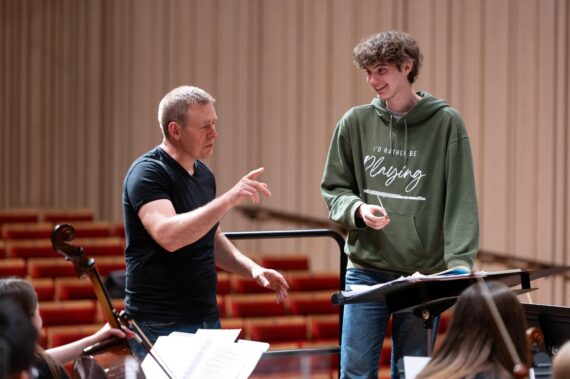
A guest blog by Tom Redmond, Joint CEO and Music Director for Chetham’s School of Music:
“Musicianship is a notoriously difficult thing to define. It’s a fluid term that occupies a continuum between practical skills and artistic vocation. At the one end is spotting a Neapolitan 6th, at the other is creative freedom and flow.
“There are, of course, many well-known approaches and methods of musicianship and the influence of Kodaly, Dalcroze, Hindemith and more can be found in so many musical settings. This mixture of pedagogical approaches is a good and healthy thing – variety is the spice of life – but it can be overwhelming for a young (or old) musician to have so many voices and ideas all at once.
“The challenge we have at Chetham’s, the largest specialist music school in the UK, is that a student can have lessons with so many inspirational teachers in various aspects of their study (instrumental, aural, analysis, composition, choral, theory etc) that there isn’t always a common language between these lessons. Yes of course, music binds it all together, but how does a young person navigate the sometimes-conflicting ideas being presented and how do you take learnings from one class to the next if the approach is not aligned? How do you make theory three dimensional; harmony applicable to a single line instrument; how do you find pulse on a page?
“Add to the mix a community of young people who join the school at any point between the age of 8 and 16, come from every background from all parts of the world and with hugely contrasting experiences and foundational knowledge, and the challenge continues to grow!
“We needed an approach that is inclusive and challenging, adaptable to multiple teaching settings, flexible between topics and genres, safe enough that people could find a way to do something new, fizzy enough that it didn’t always feel safe.
“Two years ago, we engaged the musical polymath, Dr Jonathan James to come and carry out an audit of musicianship at Chetham’s and help us find a common language across our many areas of study. Jon was perfect for this task as he knows music from every angle; he is wise, he is practical, he is creative and impulsive; he’s a reader and an improviser; he is a performer and a thinker. He’s also a thoroughly nice bloke and respected in all circles, so we knew he could navigate all areas of study with ease.
“Through interviews, practical lab session and sometimes heated discussion with multiple stakeholders we started to map out what we wanted musicianship training to look like in our environment, and beyond.
“We wanted to purposefully join the dots of all areas of study. We wanted to look for ways to connect the skills and faculties required to be a versatile, creative musician. We wanted to connect theory to practice, the inner ear to motor skills, academic vigour to interpretive practice.
“With over 100 visiting instrumental tutors coming from so many musical backgrounds there was no desire to try and dictate a precise methodology but rather give a model framework that encourages individual creativity and that can be adapted to any setting whether that be a classroom, chamber group, choral session or clarinet lesson. We wanted an approach that encourages as much playfulness, inventiveness and curiosity in teachers as students.
“The goal is to build resilience and versatility to help our students to thrive in the extraordinarily broad portfolio of work that they will undoubtedly encounter as they enter the music profession. The answer… Sign, Sing, Share. Simple!
“Three words that can be used to connect the language and approach to musicianship and be applied in any setting.
“Sign and sing should be done at the same time. To sing what is on the page while incorporating the body or movement. To feel phrases through movement or to characterise an interval with the hand; rhythms can be vocalised; scales modes and harmonic progressions can be sung and signed before any instrument is unpacked.
“Share is an invitation to explore the thinking behind the music. A chance for student and teacher to share a creative response to one another or together. In its simplest form, the concept is to pick just one fragment or idea and extend it. It could be a texture, a mood or a melodic idea. The response might be just a couple of bars, but it will be fundamental to assimilating knowledge and creative confidence.
“The use of Sign, Sing, Share can take up a few minutes of a lesson, or it can last a whole session. It can be applied to everything from set works, theory examinations, recital preparation or individual practice.
“There will be many who will say that none of this is new, and they’d be right: these are all tried and tested methods. The difference is that it’s joined up across the whole school, which means that any child joining us has the same language to navigate the challenges of musical study. No one should feel like they’re on the backfoot because they haven’t had the same training as one of their peers.
“Everyone can Sign, Sing and Share in their own way and in their own time, but they’ll do it based on the same principles of musical curiosity, resilience and creativity, and surely that can only be a good thing.”